
Free mini-lesson · AQA GCSE 3.3 · Around 15–20 minutes
Make sense of binary, one bit at a time
Understand how an eight-bit unsigned binary number represents a decimal value. Follow the example, try it yourself and explain your method.
This free web mini-lesson demonstrates the explain–practise–check approach. The paid packs are editable PowerPoints; the interactive byte below is part of this web sample. No account is needed to try it.
Start with the place values
Binary uses two digits: 0 and 1. Starting at the right, the place values are 1, 2, 4, 8, 16, 32, 64 and 128. Each value is twice the one to its right.
A 1 means include that column’s value. A 0 means do not include it.
Worked example: 00101101
00101101
The 32, 8, 4 and 1 columns contain a 1.
32 + 8 + 4 + 1 = 45
Leading zeros keep this example eight bits long; they add nothing to the value.
Your turn: build the decimal value 13
Each column holds a bit: 0 or 1. Select a bit to switch it. Add the column values with a 1. The example starts at 45.
128
64
32
16
8
4
2
1
Decimal value
45
00101101
32 + 8 + 4 + 1 = 45
Practise before checking
- Convert 00010110 to decimal. Show the column values you add.
- Write decimal 19 as an eight-bit binary number.
- A learner says 00010000 represents 8. Explain the mistake and correct it.
Check the model answers
- 22, because 16 + 4 + 2 = 22.
- 00010011, because 16 + 2 + 1 = 19.
- The 1 is in the 16 column, so the value is 16. The learner has confused neighbouring place values; 00001000 represents 8.
Discuss and apply
How does changing the rightmost bit from 0 to 1 affect the value? How does changing the leftmost bit affect it? Explain why position matters.
See real slides from the PowerPoint
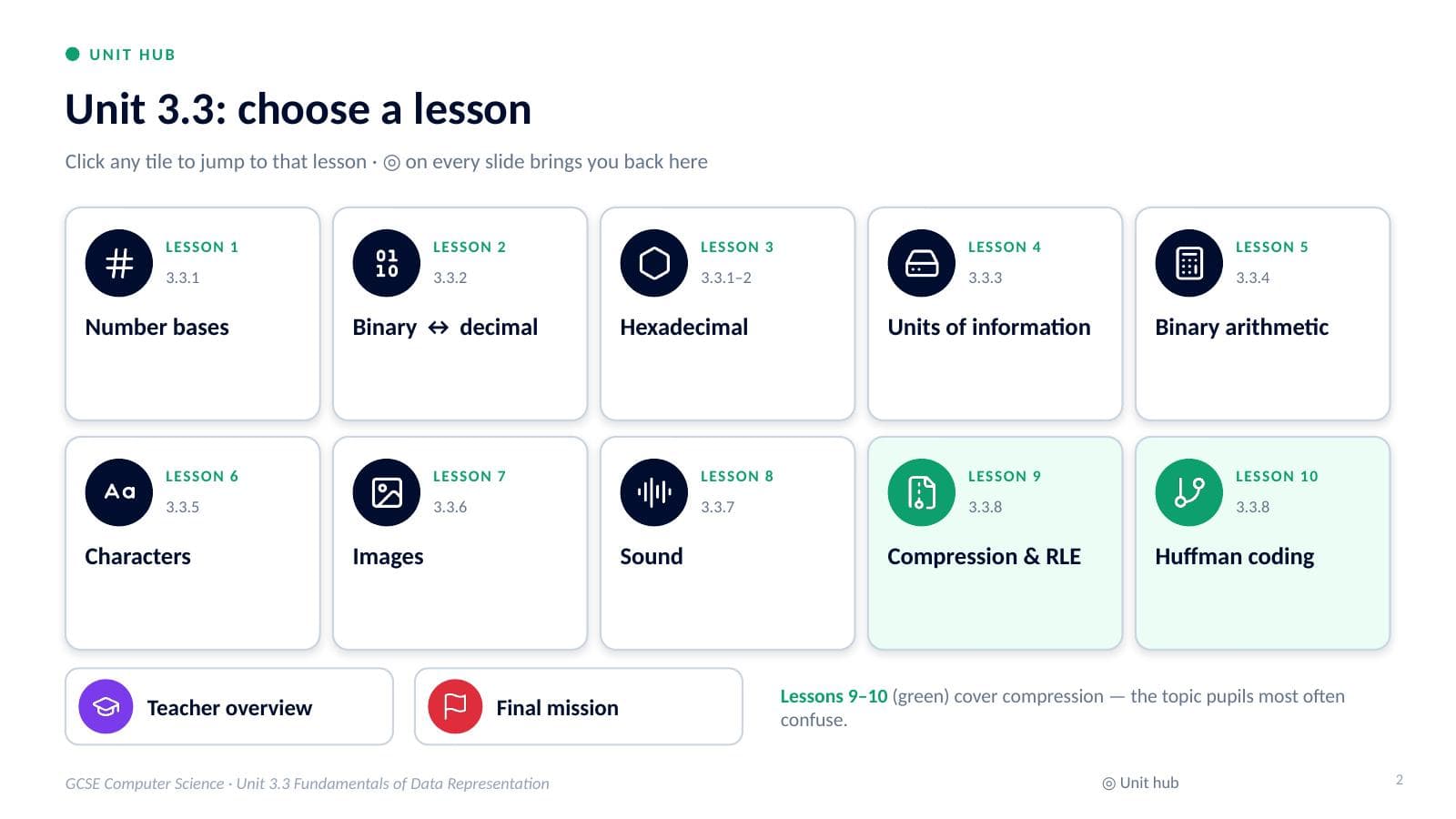
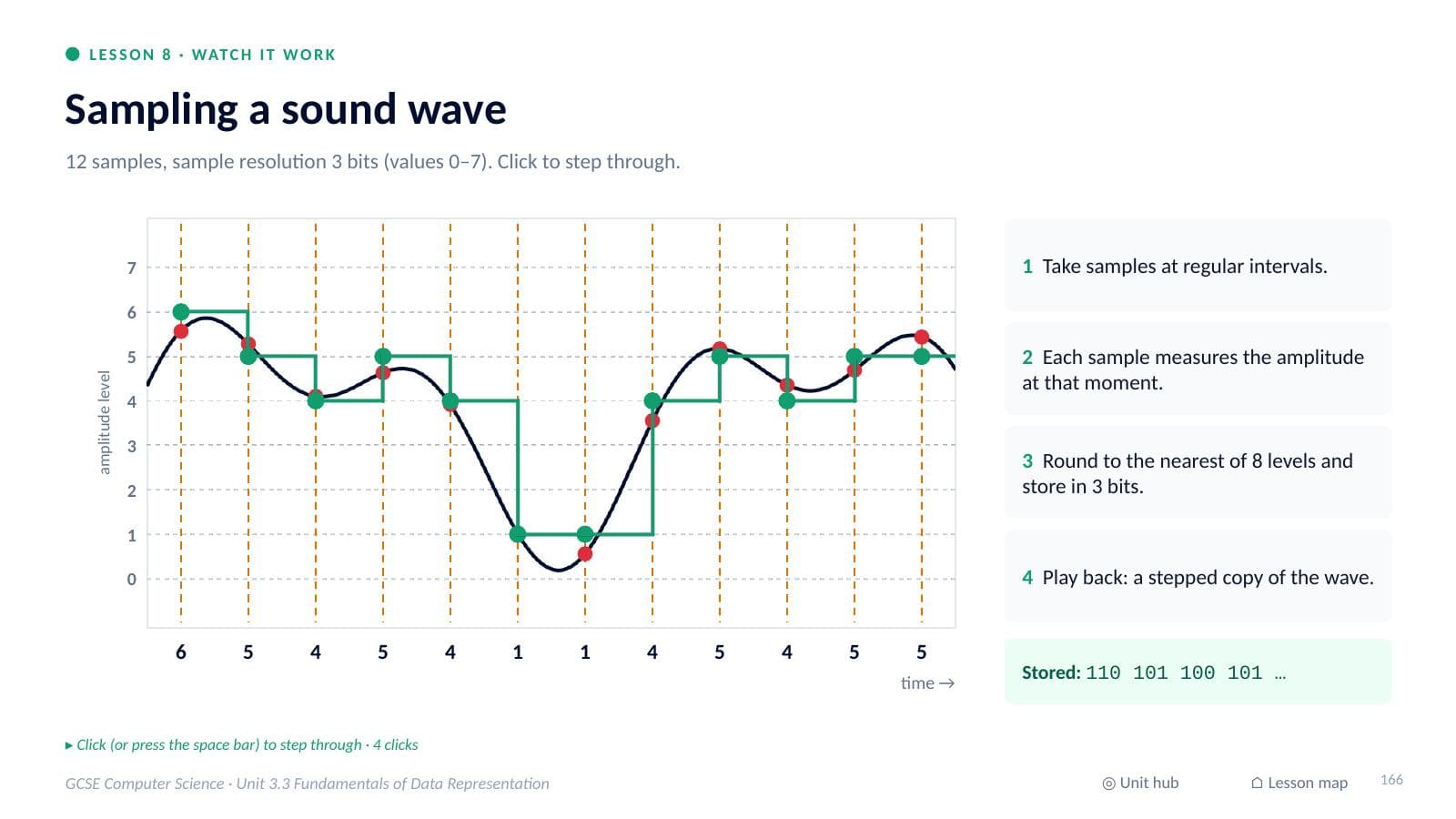
The Unit 3.3 pack connects number systems, text, images, sound and compression. These are still-image previews; use the full product page to explore the lesson sequence and software requirements.
For a home-learning session, let the learner attempt the tasks before revealing the answers. Tutors and teachers can use this public sample to demonstrate the approach. The complete packs require the appropriate licence. Independently produced by LogicPath Education; not endorsed by AQA.